I looked into Tree DP — specifically All-Direction Tree (全方位木) DP — after seeing it used in AtCoder ABC #348's E - Minimize Sum of Distance.
This algorithm is called Rerooting outside of Japan, and is a useful technique for finding the optimal root in an unrooted tree. In Korea it's treated as a subcategory of dynamic programming on trees, but abroad it seems to appear frequently enough in competitive programming to have its own name.
Concept
Tree DFS
First, let's think about how to find the total edge cost to all other nodes from a specific node. This can be implemented in $O(n)$ using DFS+DP.
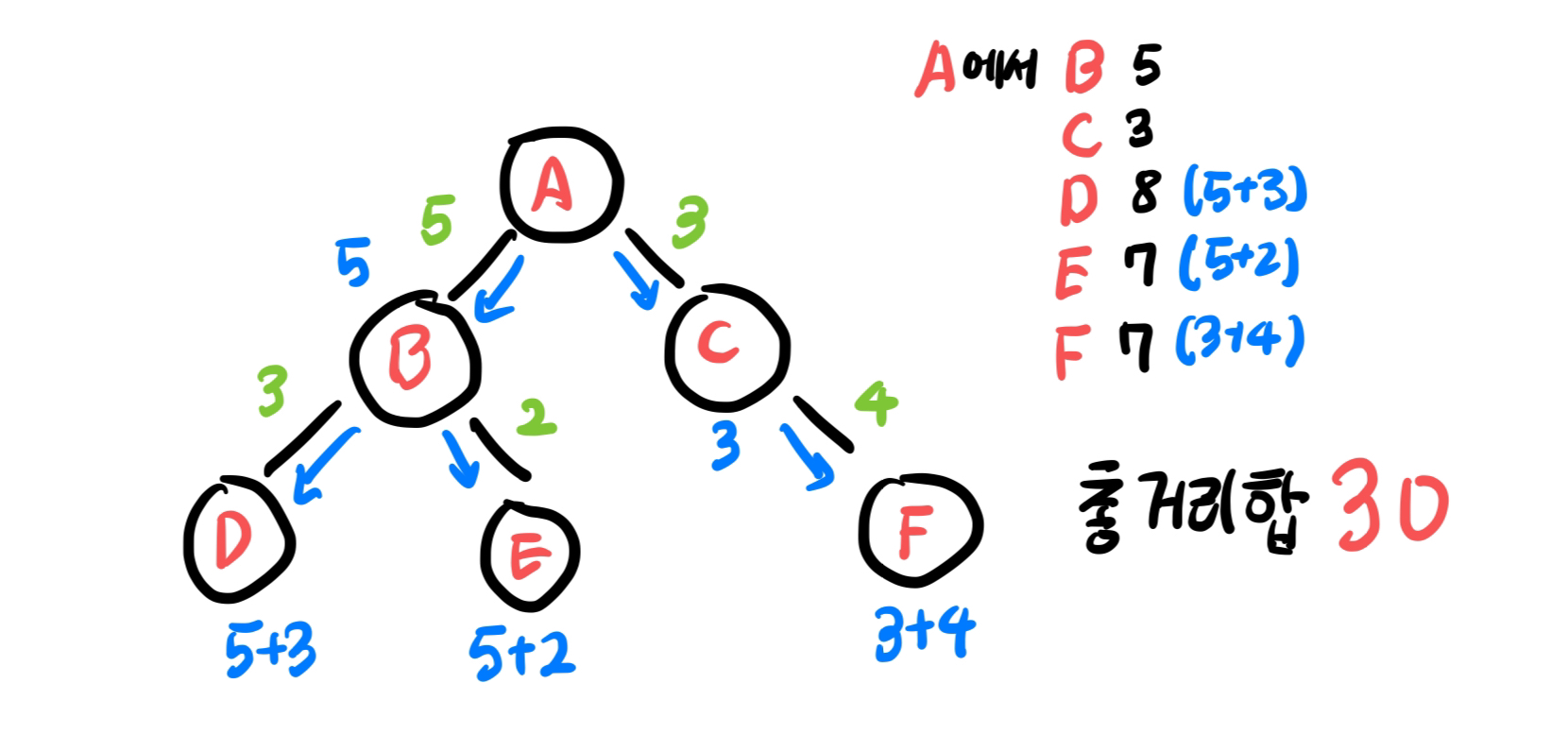
Rerooting
So how can we find the node with the smallest total edge cost to all other nodes? We could use the tree DFS described above for each node, but that would take $O(n^2)$ and would time out once the number of vertices exceeds $10^5$.
This is exactly when we use the rerooting technique. It exploits the fact that moving the root of a DFS+DP tree can be done in $O(1)$.
In the figure above, let's calculate B's total distance sum using A's total distance sum of 30. The distances from A and the nodes beyond it — A(0), C(3), F(7) — increase by the cost of the A-B edge (5), becoming A(5), C(8), F(12). The distances from B and the nodes below it — B(5), D(8), E(7) — decrease by the A-B edge cost (5), becoming B(0), D(3), E(2). Since A's increase and B's decrease cancel out:
(A's total distance) - {(nodes beyond A) - (nodes below B)} * (A-B edge cost)} gives us B's total distance sum.
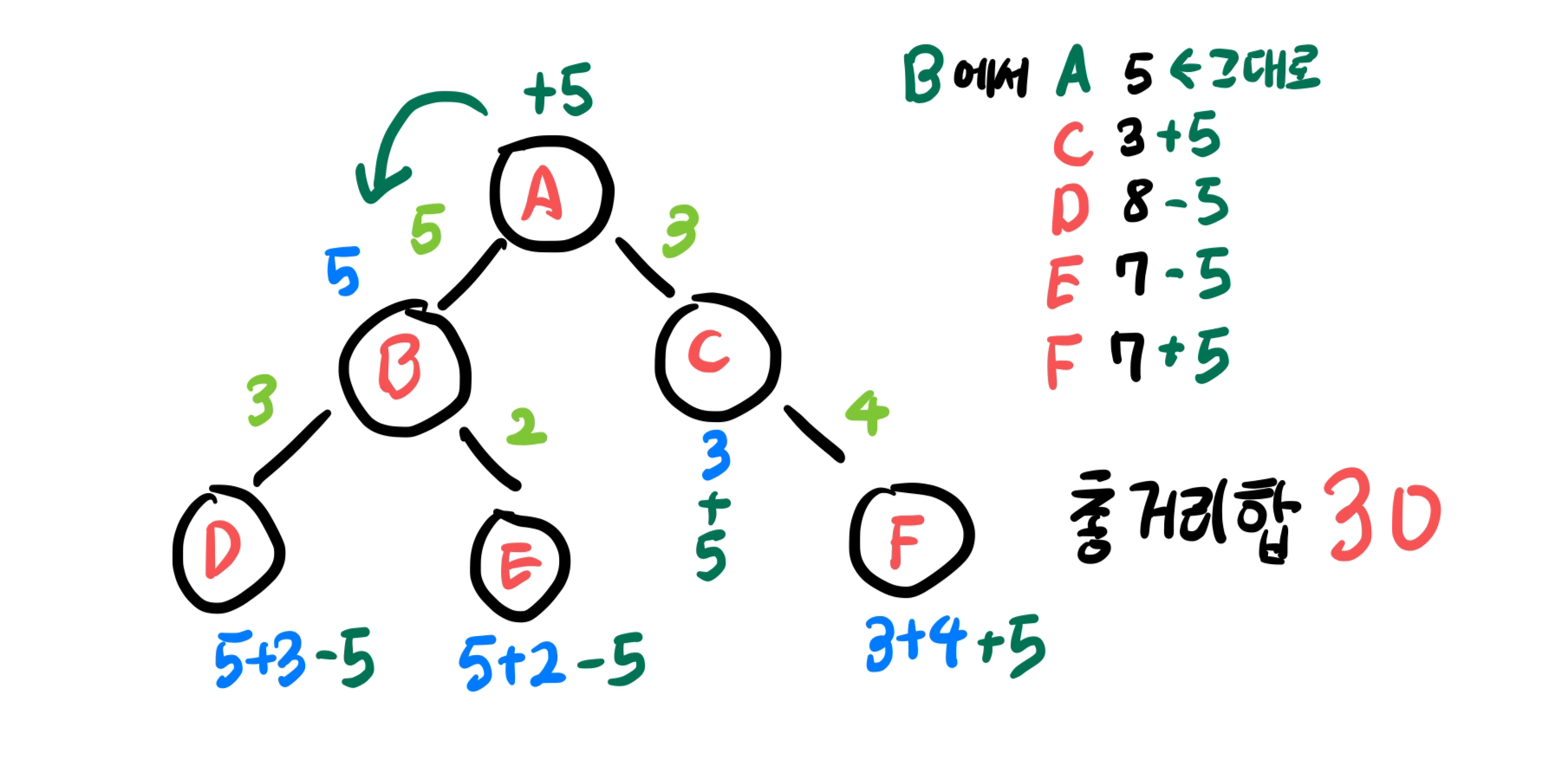
Using this method, when we know A's total distance sum, we can compute B's total distance sum in $O(1)$.
If you think of this as moving the root, it's the rerooting technique; if you think of it as running DFS searching in both directions, it's called all-direction tree DP. As with most algorithms, the name doesn't really matter.
The number of nodes beyond A and below B can be obtained by storing the count of subnodes during the initial DFS that computes A's total distance sum. In the example above, A's subnode count - B's subnode count gives the number of nodes beyond A, and B's subnode count directly gives the number of nodes below B.
Examples
BOJ 27730 : Gyeonwoo and Jiknyeo
A problem where the above example can be applied directly. Run it on two trees and output the node with the smallest distance sum from both sides.
BOJ 7812 : Central Tree
Find the central node using rerooting, then run DFS again to output distances from all nodes.
ABC#348 E
This is the problem where I first learned about the rerooting technique. Instead of edge costs, vertex costs are given.
That is, (number of edges needed to reach a vertex) * (vertex cost) becomes the edge cost.
This problem can be solved by keeping track of both the vertex cost sum c[x] and the distance sum c[x]*d.
The solution code is below, and please refer to the editorial for the explanation.
#include <bits/stdc++.h>
using namespace std;
#define llint long long int
int main() {
    int n;
    cin >> n;
    vector<int> a(n - 1), b(n - 1);
    vector<vector<int>> tree(n);
    for (int i = 0; i < n - 1; i++) {
        cin >> a[i] >> b[i];
        a[i] -= 1;
        b[i] -= 1;
        tree[a[i]].push_back(b[i]);
        tree[b[i]].push_back(a[i]);
    }

    vector<llint> c(n);
    for (int i = 0; i < n; i++)
        cin >> c[i];

    vector<llint> sub_sum_c(n), sub_sum_d(n);
    auto dfs
    =[&](auto &&self, int v, int par) -> pair<llint, llint> {
        for (int t: tree[v]) {
            if (t == par) continue;
            auto [child_sum_c, child_sum_d] = self(self, t, v);
            sub_sum_c[v] += child_sum_c;
            sub_sum_d[v] += child_sum_d;
        }
        sub_sum_d[v] += sub_sum_c[v];
        sub_sum_c[v] += c[v];
        return {sub_sum_c[v], sub_sum_d[v]};
    }; dfs(dfs, 0, -1);

    vector<llint> f(n);
    auto reroot
    =[&](auto &&self, int v, int par, llint par_sum_c, llint par_sum_d) -> void {
        f[v] = sub_sum_d[v] + par_sum_d;
        for(int t : tree[v]) {
            if(t == par) continue;
            llint nc = par_sum_c
                    + sub_sum_c[v]
                    - sub_sum_c[t];
            llint nd = par_sum_d
                    + sub_sum_d[v]
                    - sub_sum_d[t] - sub_sum_c[t]
                    + nc;
            self(self, t, v, nc, nd);
        }
    }; reroot(reroot, 0, -1, 0, 0);

    cout << *min_element(f.begin(), f.end()) << endl;
}
>> COMMENTS <<